Jocelyn Mould-Graham – Frances Mallett – Lynn Mailer – Ann Northey – Peter Northey – Maureen O’Brien
Jocelyn Edith Katherine Mould-Graham MBE (1911-2013)
A LIFE REMEMBERED
Jocelyn’s life was centred on Ireland, living with her maternal grandparents to the age of 10; Newcastle, working as conservative agent and in 1937, marrying Colonel Robert Mould-Graham TD, OBE, MC and Dorset when in 1966, she moved to Alton Pancras and the property she inherited in 1955.
Born in Fitzwilliam Square, Dublin on 11th October 1911, her maternal grandfather, Sir John Ross, in 1921 became the last chief justice of a united Ireland. He was a grammar schoolboy from Londonderry who eloped with and married Edith Mann, heiress to 50,000 acres of unproductive bogland in County Tyrone and an enormous, draughty and already crumbling 40 bedroom mansion with the romantic name of Dunmoyle. Both families while long on land, silver, portraits and pedigree were short on cash and it was from these eccentric beginnings that Jocelyn would make her own passage through life which not only witnessed but was influenced by the social turmoil and global conflicts of the 20th century.
Her childhood was impacted by the events of WW1; her father was a naval officer and her mother a Red Cross ambulance driver; her paternal uncle Arthur was shot and killed on his first day on the western front in 1915 and her mother, May, never recovered from her wartime experience, dying crippled by arthritis and alcohol in 1935.
Living with her grandparents in Ireland until 1921, Jocelyn established her primary attachments with “The Judge” (Sir John Ross) and her grandmother “Gaga”, a woman of determination and strong character. Half of this early exposure was to a Dublin torn by social troubles, rebellion and violence but also crammed with literary giants – Yeats, Joyce, Kipling and Graves – all of whom found their way to the refuge of comfort and hospitality in 66 Fitzwilliam Square. The other half was to the soft, damp silence and decay of the great haunted, crumbling mansion Dunmoyle, where the food was always cold after travelling quarter of a mile from kitchen to dining room. Jocelyn recounted impassively her recollection of “The Judge’s” car journey from Dublin to County Tyrone being shot at by the IRA and watching the machine gun squad running across the field of their ambush to “have another go” – they missed!
In 1921, aged 10, she came to Dorset where her father had bought Pitt House in Cerne Abbas. Jocelyn would ride her pony across the unfenced Giant over the hill to the Manor at Alton Pancras and with her Granny Graves (cousin to the writer/poet) would continue in the dog cart on a shopping trip to Dorchester, a journey of one hour each way. In Dorchester she would relate meeting and chatting with an affable Mr Thomas Hardy who told her that the escarpment up through Hill Wood from Alton Common was part of his setting for Tess’s imaginary post rape trek to her doomed relationship with Angel in the dairy country round Tincleton. On the journey home, they once met the steamroller on the hilly bend, above the present site of the pumping station and to Jocelyn’s delight the horse bolted! At weekends with her father she would race his wooden dinghy in Weymouth Bay until it was cut in half and sunk by a dummy torpedo fired in error from Portland when she said “she got a bit wet”.
Jocelyn went to school in Bournemouth, became a talented fencer and was shortlisted for the British Olympic team in 1928. By 1935, her Irish grandparents and her mother were dead but they and the more emancipated social environment left her with an understanding that a woman could be possessed of her own ideas and make her own way in the world while remaining a more than competent household manager, loving mother, excellent hostess and a formidably capable cook.
She trained to become a political agent and was sent to Newcastle where by 1937, after a brief interlude in 1930s Pennsylvania with her Irish emigrant cousins-cum-millionaire coal barons, she met and married Robert Mould-Graham, widower, local politician, accountant, survivor from start to finish of WW1 and Colonel of the 272 Royal Field Artillery (TA). In 1938 their first child, Joanna, was born but in 1939 he left to participate in the BEF, Dunkirk, the North Africa Campaign, the Salerno landings, finally returning in 1946 from the governate of the Amalfi Coast – she would say he was the last man in the regiment to come home ! She endured heavy bombing of the Newcastle shipyards on the Tyne, kept home fires burning, looked after new baby and 13 year old stepdaughter and organised an army of knitters to provide woollen clothing for the forces; for this she received the MBE in 1945.
After the war the couple consolidated their family life: two children were born in 1947 and ’49 respectively, they moved into a large house, Fawdon House and became heavily involved in Newcastle local political life. Jocelyn initiated her next passage as matriarch and hostess: Fawdon for Newcastle mirrored that earlier refuge for warmth of hospitality, political argument, good food and company which had been found in 66 Fitzwilliam Square, Dublin. Despite severe heart disease brought on by two world wars and assisted by a smoking habit of up to 80 John Players Richmond cigarettes a day, Robert became Sheriff, then Lord Mayor of Newcastle and Jocelyn Lady Mayoress. In 1955 Jocelyn became owner of the Manor and land at Alton Pancras and in 1958 she inherited Dunmoyle, by then principally a ruin and sold in 1960 first to a local kidnapper, who found and hid his victims in a secret passage, and following his arrest to the army who blew it up as part of a demolitions challenge in 1962. The 50,000 acres of bogland have long since been transferred by Sir John and Lady Ross to the local tenant farmers.
In 1962, tragedy struck when Jocelyn’s first child Joanna died in Newcastle from a form of leukaemia. Her commemorative window, with that dedicated to Francis Saunders and his parents, are in the church in Alton Pancras, also the brass plaque commemorating her uncle Arthur. In 1966 Robert retired, Fawdon was sold and the family moved to Alton Pancras where the Manor House became Jocelyn’s new centre of hospitality and from where she continued in community works as director of the Victoria League and later as Commandant of the Church Girl’s Brigade.
When Robert died in 1979, Jocelyn became the family matriarch; from 1992 onward she suffered osteoporosis fracture injuries which by 2005 had made her bedridden. Moving to care homes in 2012, she became increasingly demented but throughout this period of decline she remained a dedicated and hospitable matriarch. By her death her family had swollen to 31 children, grand children, great grand children and great great grandchildren. They remember, even in her lowest moments, a cheerful smile, a cry of “walk-onin”, being uniquely cherished and the compulsory drinking of a glass of sherry at any time of the day!
Her funeral at the church at Alton Pancras – on what would have been her 102nd birthday on 11 October – was the last clan reunion around a strong, independent personality who lived a full and fruitful life. She was buried in a rather Irish wicker coffin laced with roses and she lies now in the south west corner of the church yard which she chose after consultation with her friend Sally Dangerfield, a spot which gets plenty of sunshine and has a good view of her beloved Manor and the downland around the church. It was a day of celebration but with a tinge of sadness for the passing of someone who to her friends and family had for many a long year been both uniting and iconic.
Andrew Graham
Frances Mallett (2022)
Frances Mallett of Alton Pancras died aged 95 in April. She and her husband Charles, both Londoners, retired to the Piddle Valley in 1976. A Summer holiday spent near Abbotsbury had convinced them that Dorset was the place in which they should spend their retirement years. They found a neat bungalow at Alton Pancras, with a good sized garden which they decided would suit them, and their pet whippet, very well. There was no better place to exercise a whippet than on the surrounding downs. One of their whippets gained quite a reputation in the valley. Barley was a rescue dog, needy and neurotic. One day he was left in the car for a while, something spooked him and in his agitation he managed to chew through the seat belts. No longer could he be left alone. Thereafter, with the agreement of Revd Derek Parry the vicar, Barley attended church with his owners, lying happily under the pew on his blanket, a respected member of the congregation.
The Malletts blended well into the community. In London they had tended their small garden and were knowledgeable about plants. Frances was proud of the fact that shrubs they had brought with them 30 years before were still thriving. They became members of the Garden Club, attended church regularly and took on PCC tasks. Frances had opportunities to use her musical skills, joining valley choirs and playing the organ at St Pancras church. She was one of those who designed and stitched kneelers for the church. Frances had the energy to be an active member of the village and to pursue her own interests at the same time. She was knowledgeable about literature, drama and music, having enjoyed theatre and concerts in London. Her education had been hugely upset by World War II (she celebrated her 13th birthday in July 1939, just before many London secondary schools were either closed or evacuated) and she longed to make good the lack of formal study during her teenage years by studying for an Open University degree in History and Literature. She and Charles learned to use a computer, which proved very useful for writing and submitting her assignments and communicating online with tutors. Charles died in 2005. Frances, alone for the first time after over 50 years of marriage, made the inevitable adjustments to her life and continued to find pleasure in the countryside, her garden, reading, music and village activities. Only in the last few years did her health begin to fail, but she remained at home until a few weeks before her death, thanks to the steadfast support of friends and neighbours.
Pat Kenwrick
Lynn Mailer (3/1/66 – 15/2/22)
Lynn was the youngest daughter of Audrey and Johnny Warren and grew up in the Piddle Valley and although moving house a few times, she lived in the Valley for all of her life. She attended Piddletrenthide School and then the Green School in Dorchester. During her childhood Lynn had friends that lasted a lifetime, particularly Jenny Walsh (nee Osgood) and Caroline Kellaway (nee Abbot).
Lynn and her older sister Susan shared a love of dogs, encouraged by their father, and, thanks to encouragement by Mr Kerns and Caroline Kellaway, Lynn also loved horses. During her entire life Lynn loved the world of horses, from National Hunt Racing, Point to Pointing and hacking out on one of her own horses, Cressie and Foxy.
Upon leaving school Lynn went to work for Dorset Fire Service in the Control Room. She proved calm, competent and efficient and through various promotions rose to Watch Manager. At her funeral, Ben Ansell the Dorset Chief Fire Offcer, gave a moving tribute to Lynn and her 29 ½ years with the Fire Service.
In May 2000, whilst enjoying Weymouth Trawler Race Day, Lynn met Alistair Mailer, who at that time was serving in the Army. This was to be a turning point in her life. Lynn and Al became engaged on New Year’s Eve 2003 and were married in Las Vegas on the 22 August 2004.
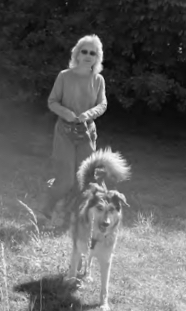
Lynn took early retirement from the Fire Service in 2015 as Dorset Fire Service combined with Wiltshire to form the Dorset and Wiltshire Fire Service, and the Control Room moved to Devizes. She began working for Equine Rescue Service. Al left the army and worked as Co-ordinator for Arboriculture Apprentices at Kingston Maurward College. In addition to working, Lynn and Al became interested in dog agility and trained their dog, Chapi, with Sturminster Newton Agility Club. After their frst dog Billy, passed away, Lynn and Al gave a home to Chapi, a rescue dog from Rushton Dog Rescue. Travelling formed an important part of Lynn and Al’s life and they traversed the world visiting many countries from continents as diverse as South and North America, Africa, Asia and Europe.
Lynn was an active member of the Piddle Valley Parish Council where she worked hard to get a defbrillator for Piddletrenthide. She was on the Community Cars Committee and was one of the major organisers of the Save the Piddle Inn Group. Lynn and Al were also involved with the production of the Piddle Valley News and Views, Lynn dealing with the advertising side and Al editing. Lynn was also a co-ordinator for the Piddle Valley Facebook Community Group.
Lynn sadly succumbed to Pancreatic Cancer on 15 February 2023. Lynn was a prominent and popular fgure in valley life and her loss at such an early age has saddened the community.
Janet Keen
Ann and Peter Northey
LOSS OF TWO DEAR FRIENDS
This year Piddletrenthide lost two very dear friends; Ann and Peter Northey who moved here in the 1990s. Peter and Ann were devoted to one another, and were married a few weeks short of 50 years.
Excerpts from the eulogies given by Mark Northey for his father Captain Peter Northey. RN MVO and his mother Ann Northey:
“Dad was born in 1927 in Ealing but spent much of his early life in Barnet with his 2 sisters plus holidays in Devon where the family are from. He told us of stories of hiding under the kitchen table as bombers roared overhead and his father lifting him up to see London burning in the blitz.
He never ceased loving Dartmoor where he loved to walk. At school he was a noted athlete including at Junior County level, before joining the Royal Navy as an officer cadet in 1945. He was aboard the Frobisher in Northern Scotland on VE day and was subsequently sent to Australia to join his first ship the light cruiser, Newfoundland. For the next 20 years he spent time in the Far East and Mediterranean serving in a variety of ships, (including the Royal Yacht Britannia) and taking part in the Korean war. He also worked in the First Sea Lord’s Office in the Admiralty
Mum and Dad adored one another and were still full of delight at having found each other later in life. They shared a love of gardening and crosswords but were also fiercely independent.
Dad was a prodigious hard worker. After leaving the navy in 1980 he worked as a Chief executive of a charity for schools in the UK
Being 90 did not stop him crawling on the floor with the grandchildren when there was mischief to be had.!! When he retired he learnt to ski and back-packed around Chile and Argentina with his twin daughters.
He came with Mum to Piddletrenthide in 1998 and loved being part of the village and the church. He was bowled over by the kindness shown to him by villagers in the last few difficult months.
To the end Dad remained the perfect gentleman, insisting he walked on the outside of the pavement and opening the car door for Mum. He continued his love of walking to the end – not the long jaunts across Dartmoor but religiously at 6.30am every morning to exercise the pooch.
Mum was never one for the limelight.
She measured her success in how happy people were around her. Her most enduring quality was putting others first. We named her the Mummy Martyr. Like her father before her she was at heart a public servant in the fullest sense of the word. Mum was born in Dublin 20 minutes after her twin sister. During the war the twins were left in Ireland with their Granny while their parents returned to work in Sudan. It was probably this that made Mum so determined to keep her own family so close knit.
She had a disjointed education all over the world. She became a Secretary in the Foreign Office working first in London, then Baghdad, Ankhara and Geneva. Here she worked for the National Book League and then Trinity College Cambridge before heading to Canada and San Francisco. From San Francisco she embarked on an epic trip across Asia back to Europe via Hawaii, Japan, Cambodia, Pakistan, Iran, etc.
Mum and Dad met in London. Dad made Mum wonderfully happy. Not even her illness could dim her radiant smile every time he entered the room.
What we remember most about Mum was…
- Her wonderful stories about life in Africa.
- That she hated cooking but could put on a wonderful spread.
- She inspired all three children to read History at University and to travel.
- Her love of young people and her skill at entertaining them.
- Her delight in hurtling along roads earned her the family nickname of the yahoo. She was also a phenomenal navigator.
- She was a very keen gardener and had an encyclopaedic knowledge of plants and trees.
But above all she had that very special quality of putting others first. She worked in Dorchester for the Citizens Advice Bureau and cared for many elderly relatives.
Caring for all of us, because that was who she was.”
Mark Northey
Maureen O’Brien (2020)
Maureen O’Brien, recently of Casterbridge Manor Nursing Home, Cerne Abbas, and previously of Paynes Close, Piddlehinton, passed away peacefully in her sleep on the evening of Tuesday 7 April, 2020, after a short illness.
Her family would like to thank all those friends who stayed in touch through their visits or by regular enquiries in person or by telephone. Following a graveside service to be held at Ham Down Burial Ground, Shillingstone, Blandford, on 23 April, a Memorial Service of Thanksgiving will be held in Dorchester at a later date. May she rest in peace.
Chris Tozer
 Piddle Valley News and Views